Stretching: The Elastic Edge
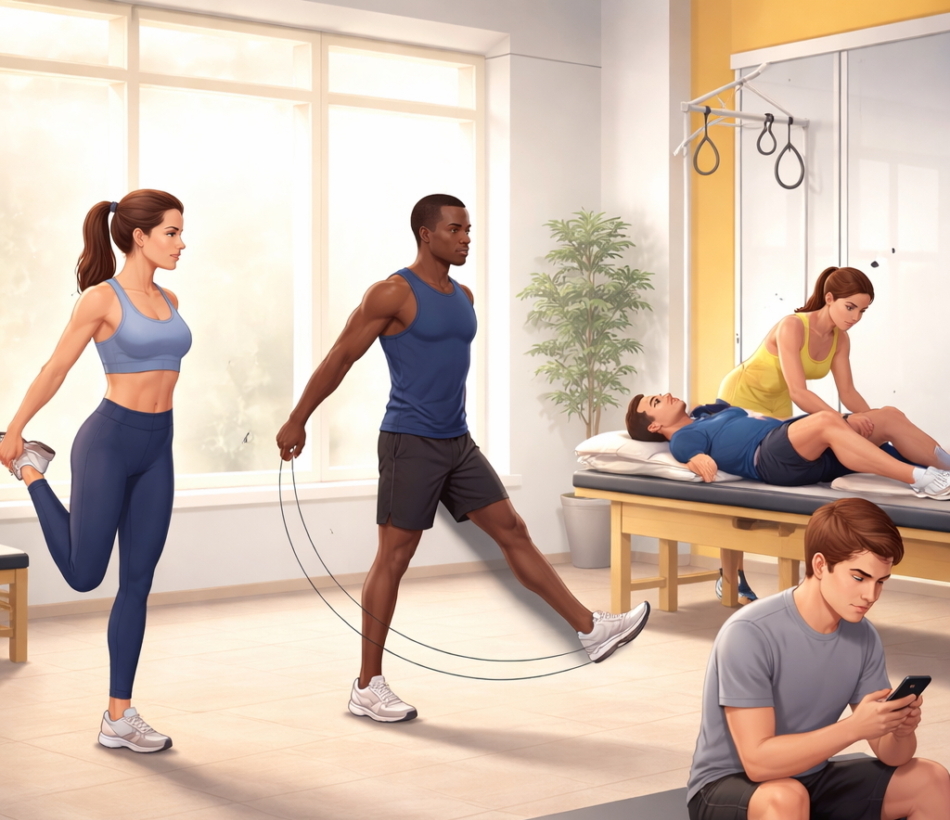
Then opinions shifted, and it got questioned – even sidelined.
Stretching hasn’t lost its value, it’s widely misunderstood. To unlock its full potential, we need to look past the myths
Stretching, Out of Context
For years, stretching was a mainstream fitness staple. Athletes holding static poses – chasing flexibility, injury prevention, and performance – were a familiar gym scene.
Then long-held assumptions were challenged. Evidence showing that static stretching before exercise could blunt performance sparked a narrative shift.
Stretching went from essential to questionable – and potentially harmful.
Today, that familiar gym scene looks different.
While weight rooms are packed and cardio machines are buzzing, stretching areas suffer inconsistencies. Some hold, others swing, many improvise – when the space is not repurposed as a lounge to unwind and scroll.
Without a clear framework, confusion persists – what we understand about warm-ups & recovery, and what we do rarely matches.
Stretching is due for another repositioning: used with intent, stretching remains a powerful tool for performance and longevity.
Stretching vs Mobility: A False Choice
At its core, stretching is less about chasing flexibility or range of motion in isolation, more about recalibrating how the nervous system allows movement.
Muscle fibers do elongate when stretched–but only temporarily. The more meaningful adaptations occur within the neuromuscular and tendinous network, where sensory receptors protect against overstretching.
Repeated controlled stretches teach the system to relax: parasympathetic system takes over, neural brake releases, resistance to stretch – or stretch reflex – dampens, and stretch tolerance & range of motion increase.
This is how static or passive methods – holding a pose or externally applying tension using a weight or an elastic band – builds range & capacity. Techniques like PNF (Proprioceptive Neuromuscular Facilitation), combining stretching with targeted muscle contractions and controlled breathing, amplify this effect and further unlock deeper range.
But range alone doesn’t translate to performance.
Dynamic approaches – going through sport-specific movement patterns, swings, or light compound exercises – work differently: activating the stretch – shortening cycle (SSC) and priming the neuromuscular system for coordinated and efficient force transmission.
Here, mobility builds control
Once movement is organized, stretching can also become a simple system check. Controlled end-range and mobility drills reveal asymmetries, resistances, or pain points–often buried under load.
The right pull for the right moment: before training, prioritize dynamic movement to prepare the system. Reserve static work for recovery or separate sessions, when the goal is to restore range and reduce tension.
Stretching Beyond The Myths
Myth 1 – Stretching is essential before every workout.
Not all stretching belongs in warm-ups. Prolonged (>30 seconds) static hold can temporarily reduce muscle and tendon stiffness, dampening force transmission & neuromuscular firing speed.
Counterproductive before explosive or power-based efforts, static stretching becomes relevant in lower-intensity context and where end-range is required.
Myth 2 – A flexible muscle is a weak muscle.
Partially true, and at the heart of the stiffness paradox.
In the short term, static stretching neuromuscular relaxation can slightly blunt explosiveness. But over time, increased usable range improves coordination and builds compliance – supporting movement quality and reducing injury risk.
For most, long-term gains in movement quality outweigh the short-term dip in performance.
Lower stiffness favors mobility. Higher stiffness supports explosiveness. The key to performance is balancing these qualities.
Myth 3: Stretching accelerates recovery and prevents injury.
Stretching post-exercise has limited impact on soreness and objective markers of muscle damage. There is no muscle detox happening.
Its influence on blood flow is modest and is far outweighed by active light recovery, and it could even interfere with strength and hypertrophic gains.
However, the "feel-good" factor is non-negligible, especially if combined with mindfulness and breathing exercises. Over-time, it still supports proprioception, posture, and musculoskeletal comfort.
Myth 4: Pain is gain.
Stretching is less about chasing pain than it is about teaching the body to mute movement resistance signals. Productive stretching is controlled and progressive–tension should ease, not escalate. Instead of chasing maximal range, aim for symmetry, awareness and gradual fading of muscle tensions.
Bottom — Line
Like other overlooked recovery tools, stretching often sits in the background: inconsistently applied, loosely defined, and rarely integrated with intent.
Used with intent and in the right context, stretching supports performance, mobility, and healthspan. The limitation isn’t effectiveness, it’s application – and that’s beginning to shift.
Flexibility is being reframed. Community formats like yoga and Pilates continue to scale as guided stretching experience, while assisted concepts like Stretchlab and iflex are adding structure and standards.
Mobility is also becoming programmable. Platforms like Pliability (Hyrox partner), GOWOD or Bend are embedding structured routines into training–stretching SaaS model, and acronym.
Looking ahead, the evolution may go even further. Robot-assisted massaging devices like Aescape hint at a future where stretching becomes automatized and customized.
The industry and athletes are continuously looking for low-friction signal – a true stretching equivalent of HRV. Yet, as stretching becomes more structured, guided, and eventually quantified, it may remain one of the last domains mostly guided by feel.
